Multimedia Story
For my multimedia story, I hiked to Quarry Rock through the Baden Powell Trail in North Vancouver. Instead of simply pointing a camera at the final lookout, this project deconstructs the hike using the trail’s seven distinct bridges as structural waypoints. The resulting story integrates text reflections, video footage from the trailhead to the summit, and ambient audio of the environment, such as river systems flowing beneath the path, wildlife, and other sources of nature!
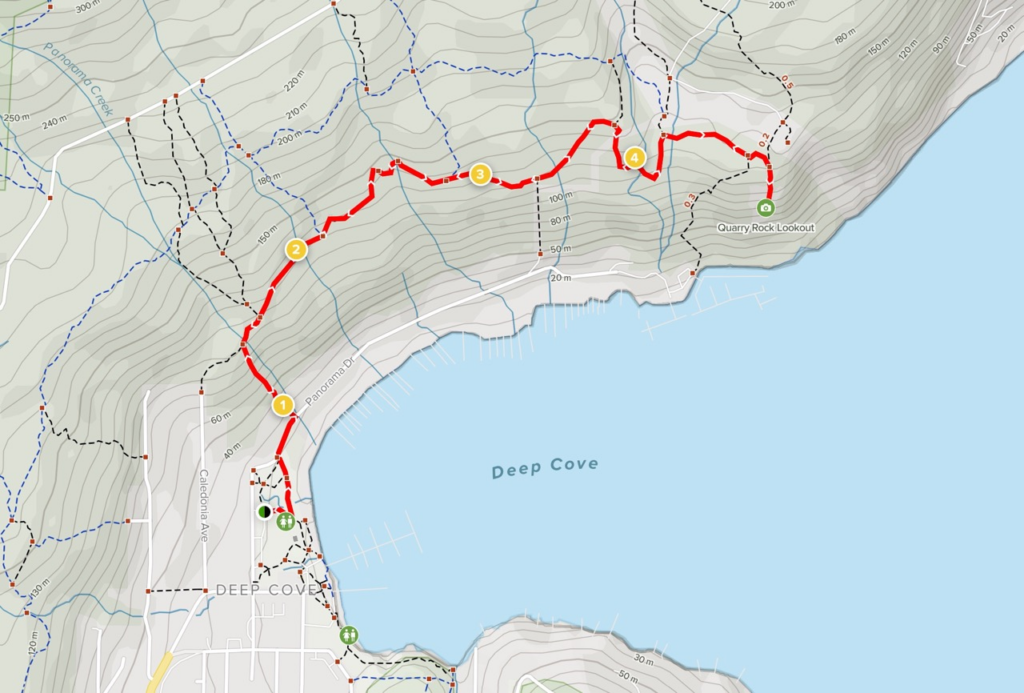
Firstly, initiating this hike in the evening was a deliberate choice. When documenting a physical environment, managing the variables of that space is critical to the final output. By starting the hike at sunset, the goal was to get to the peak early enough to view the scenery, and to mitigate the high volume of foot traffic that typically follows this route, allowing for cleaner audio and video capture.
The journey began at the base in Deep Cove. Before even stepping onto the trail, a few seals happened to appear at the shoreline (that I nearly missed out on if it were not for some fellow hikers).
The transition onto the Baden Powell Trail is immediate, marked by a notoriously long flight of wooden stairs. This initial climb establishes the physical demand of the route right away.
Structural Waypoints: The Lower Bridges
As the elevation increased, the trail’s structural waypoints (bridges) began to dictate the journey.
The first bridge offered an interesting observation in environmental shifts. Currently, there is no water flowing through the creek beneath it. In the wetter fall and winter months, this is a highly active piece of water, but the dry spring and summer conditions completely alter this segment of the hike.
Shortly after, the second bridge presented a contrast in the trail’s infrastructure. Unlike the traditional wooden structure that characterize most of the local trails along the Baden Powell, this is a newly installed, non-wooden bridge.
The auditory environment shifted significantly at the third bridge. This was the first structural crossing with actively running water beneath it. The sound of the river provided a natural auditory layer that had been absent in the earlier sections of the hike, adding another level of natural, sensory experience of the trail.
Navigating the Mid-Point
The fourth bridge is a smaller, more understated structure crossing another dry bed. It acts as a brief transitional marker before the terrain starts to consist of mainly wooden crossings and trail.
By the fifth bridge, the integration of human engineering and the natural environment becomes more pronounced. This crossing is part of an extended wooden pathway that feeds directly into another steep flight of stairs, which demonstrates how the trail adapts to the aggressive topography of the North Shore mountains.
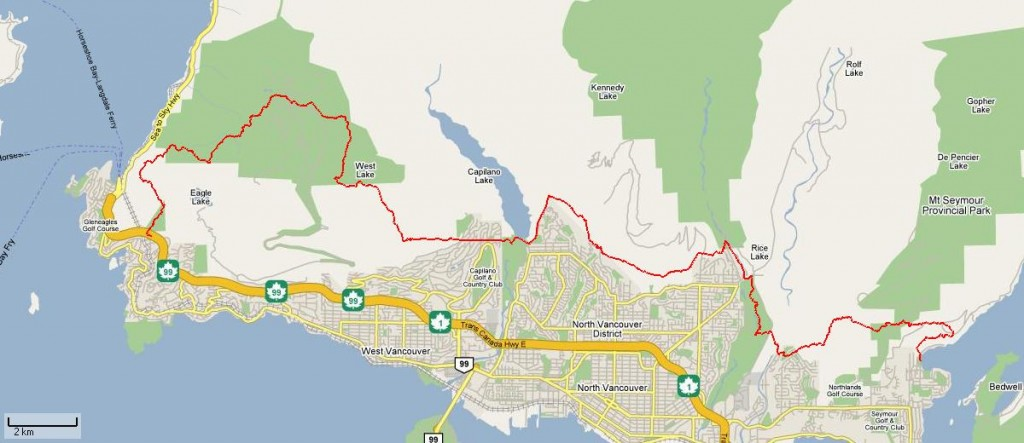
I also noticed the official trail markers more frequently during this section. These markers act as a system of navigation, assuring hikers of their progression and location within the broader network of regional trails. The official Baden Powell trail encompasses the entirety of the North Shore mountains and flows from Horseshoe Bay in West Vancouver all the way to Deep Cove, and the start of this Quarry Rock hike.
The Final Approach and Summit
The sixth bridge functions more as a staircase than a traditional crossing, physically elevating the path and leading almost immediately into the seventh and final bridge. This part of the hike is highlighted by a sudden collapse in terrain, pretty much acting as a landslide. This is likely new to the hike as it has been a few years since reaching this hike again and I had not noticed it before, as well as there being caution tape and temporary signage in the surround area. Reaching this final-bridge waypoint is the definitive indicator that the trail is about to end and you are close to the final destination.
Emerging onto the open face of Quarry Rock, the timing proved to be worth the journey. The final light of the day was a pink and orange gradient across the sky. The space was shared with a few fellow hikers quietly taking in the expansive views of Indian Arm. Looking down at the water, the scale of the environment was emphasized by the small silhouettes of boats, kayakers, and paddle boarders making their way through the inlet below. Up at the peak you can hear more of the wind surfing through the air and the water sifting across the shore.
The Descent
As the light rapidly faded, the trail became significantly more difficult to navigate. Recognizing the limitations and risks of the environment, I made the conscious decision to not record the journey back, as it is also the same way we came through. Prioritizing physical safety and accurate footing over capturing the descent was essential.
By the time I reached the bottom, the sun was almost completely gone. Deep Cove had returned to a quiet, peaceful state, concluding the journey just as darkness fully set in. The hike was a reminder that while technology allows us to capture and structure our experiences, adapting to the physical realities of the environment must always take precedence.
Reflection and Principles
As this project transitioned from an initial concept to a finished artifact, the focus shifted toward how the audience actually processes this form of media. Building an immersive experience is not just about capturing high-quality content, but also about structuring it so that it manages the cognitive load effectively. I applied several of Mayer’s Principles of Multimedia Learning to shape the narrative of this story.
- Segmenting Principle: Rather than presenting the hike as a single, continuous vlog, the journey is broken down into user-paced segments. Each of the seven bridges acts as distinct chapters of the story. This allows the audience to process one physical and narrative milestone at a time before moving on, preventing cognitive overload.
- Coherence Principle: By strictly utilizing the natural audio recorded in the videos and the standalone audio track of the flowing river, extraneous material is excluded. The focus remains entirely on the essential environmental nuances.
- Pre-training Principle: The project utilizes forming the structure of the story early, rather than explanations during the visuals and audio. This ensures the audience understands the foundation and reasoning behind both the multimedia choices and the story of the hike itself.
- Spatial Contiguity Principle: To ensure the digital layout supports the learning experience, all textual reflections and captions are embedded directly adjacent to their corresponding bridge videos. Viewers do not have to scroll away or search for context. The visuals and text are consumed in the same frame.
Feedback and Delivery
A critical part of refining this project was the peer review process. Initially, I planned to have the video clips play continuously one after the other. However, feedback from peers highlighted that this created a rushed pacing that didn’t accurately reflect the physical effort of the hike.
The biggest decision made during this process was how to re-frame a highly popularized trail in the community. Quarry Rock is heavily documented online, and I wanted to ensure this didn’t just reproduce the standard “travel recap” stereotype. By anchoring the narrative to the seven bridges rather than just the natural landscape, the project challenges the standard way this environment is usually presented.
Executing this vision came with a few significant challenges. The Baden Powell trail is incredibly busy, and capturing clean, isolated media required patience. There is a lot of background conversation and foot traffic on the trail, which threatened to disrupt the coherence of the ambient audio.
To overcome this, I went at a later time of day, as well as on a weekend, to mitigate some of these potential disturbances. While on the trail, I stopped and waited to capture the environment’s audio. I also happened to catch myself heavily breathing at times, leading to rerecordings of certain clips!
Ultimately, this project reinforced that digital literacy goes beyond simply knowing how to operate a camera or an editing software. It requires a critical awareness of pacing, structure, and the underlying systems we use to represent our physical experiences in digital space.